
The Bible, for everyone, easy to read.

Meet Plainword
A free Bible app for every Christian tradition, made for anyone who finds the Bible hard going. Large, calm type, plain meanings for hard words, and a voice that reads it to you. No account, no ads, no streaks.
Easy To Read, and To Hear
Plainword brings the Bible to everyone by providing:
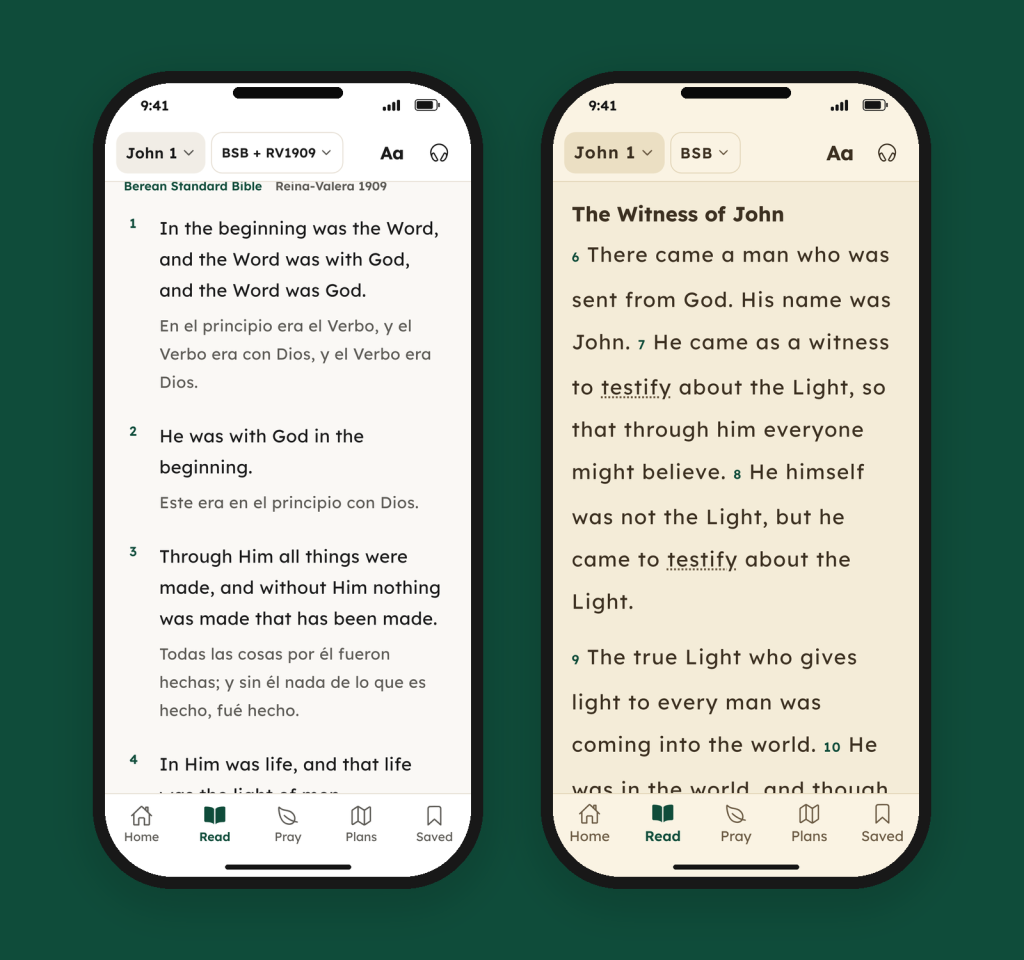
- Large, clear type in Lexend, a font designed to make reading easier. You can turn it off, change the text size, and choose from three line spacings.
- Light, sepia, or dark pages, and a reading ruler that shades the verse you’re on.
- Plain meanings. Tap a word with a dotted line to see what it means, from over 330 hard words, old words, places, coins, and measures. Save the ones you want to remember.
- Read aloud. Your phone or computer reads verse by verse, shading the verse and, on most devices, lighting up each word. Pause, skip, or slow it down whenever you like.
- Choose a verse. Highlight it in one of four colors, write a note, bookmark it, share it, or listen from there. Your highlights and notes stay with the verse when you switch Bibles, even where Bibles number verses differently, like the Psalms in the Douay-Rheims.

For Every Tradition
Plainword is here for you, no matter what path you take:
- Seven Bibles: the Berean Standard Bible (clear, modern English, and the place to start), the Bible in Basic English (about a thousand simple words), the World English Bible, the King James Version, the Douay-Rheims, Young’s Literal Translation (word for word, for study) and the Spanish Reina-Valera 1909. All seven are in the public domain in the United States.
- Your book list: Protestant (66 books), Catholic (73), or every book in your Bible, including those some Orthodox Bibles have. Plans and prayers follow the list you choose.
- Translation notes: 32 short notes on verses where Bibles translate a word differently, where old copies differ, where a well-known verse is best read in its setting, or where scholars read a passage differently. Facts and sources, side by side, with no side taken.
- Prayers for everyone: every prayer and note is written for Christians of every tradition.
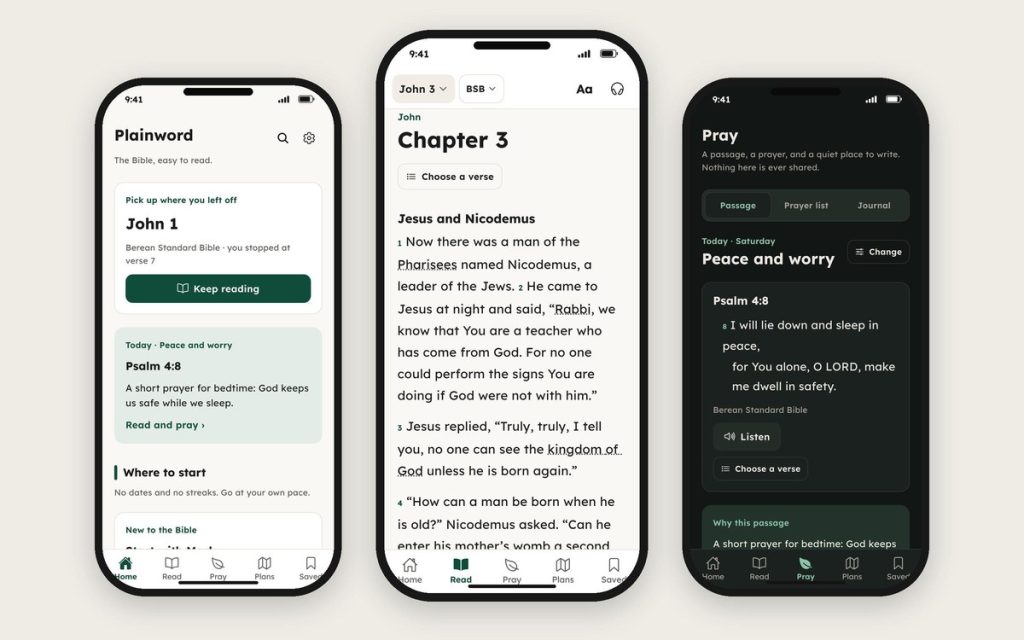
Prayer and Passages
Pick up to three things you’d like help with, like Peace and worry, Grief and loss, or Starting over.
Plainword suggests a passage and a short prayer each day, week, or month, from 176 written ahead of time for Plainword, and never repeats one until you’ve seen the rest.
Keep a prayer list and a journal beside them. On a phone, you can turn on a gentle reminder.
Private by Design
- No account, no sign-in, no ads and no trackers.
- Your highlights, notes, prayer list and journal stay on your device (and in your phone’s own backup, if you use one). Mars Theory never receives them.
- Moving to a new phone or computer? Make a free backup file in Settings and open it on the new device. It goes only where you put it.
- Use Logos Bible Software? You can turn on an Open in Logos button. Logos sees a verse only when you tap it.
Reading Plans with No Dates
Start with Mark, The big story, Psalms for hard days, Wisdom for every day, The Gospel of John and The Gospel of Luke, plus Tobit for Catholic and Orthodox book lists.
Go at your own pace. Plainword never says you’re behind.
Free, With an Optional Plus+
Reading all seven Bibles, read-aloud, plain meanings, translation notes, Open in Logos, and every reading-comfort setting are free for everyone, always, along with prayer for up to three topics and the plans above.
Plainword Plus adds more for going deeper:
- Two Bibles side by side, including English and Spanish
- Every prayer topic, and four more plans: Genesis, Acts, Short letters of hope, and The whole Bible
- Word study: the Hebrew, Aramaic or Greek words behind every verse of the 66 books every Christian Bible shares, with dictionary meanings and every other verse that uses them
- Grammar in plain words: in word study, what each word is doing in its verse, like who is acting and when
- The Brown-Driver-Briggs Hebrew dictionary (1906), the classic scholars’ lexicon, for nearly every Old Testament word
- Related verses: other places the Bible talks about the same thing, each with its words
- Send my notes: your notes, highlights, bookmarks, prayer list and journal as plain text, to email to yourself
Plus is free for everyone during the beta. When Plainword opens to everyone, Plus is planned at $3.99 a month or $29.99 a year, or $44.99 a year for a family of up to 6, with 7 days free, bought through the App Store or Google Play.
Frequently Asked Questions
Which Bible should I start with?
The Berean Standard Bible, if you’re not sure. Choose the Bible in Basic English for the simplest words, the King James or Douay-Rheims if you love traditional words, the World English Bible for modern English with every book, or the Reina-Valera 1909 in Spanish. You can switch any time.
Is Plainword for my church?
Plainword is for Christians of every tradition. Choose a Protestant, Catholic, or full book list, and the prayers, plans and notes are written to welcome everyone. Notes on debated passages give the facts and sources and let you decide.
Does it work in Spanish?
You can read the Reina-Valera 1909, and with Plus, read it side by side with an English Bible. Plainword’s menus and plain meanings are in English for now.
Is it safe for children?
Yes. Plainword has no accounts, no ads, and no way to see or message anyone, and it asks for nothing about you. It’s written for readers of every age.
Does it work for people who use a screen reader or keyboard?
We aim for the WCAG 2.1 AA accessibility standard, and testing is under way. Every button has a spoken name, verses can be chosen without tapping the text, and the Spanish Bible is read with a Spanish voice.
View our accessibility efforts here.
Where does the word study come from?
The Hebrew, Aramaic and Greek words, their short meanings and the grammar explanations come from STEPBible, by Tyndale House, Cambridge (CC BY 4.0). The longer dictionary entries are public domain: G. Abbott-Smith’s Greek lexicon (1922), and James Strong’s Hebrew dictionary (1894) and Brown, Driver and Briggs’s Hebrew lexicon (1906), both from the Open Scriptures project (CC BY 4.0).
Related verses are OpenBible.info’s cross references (CC BY). The Bibles themselves are in the public domain in the United States too.
How do I try it?
Plainword is in a small private beta now. Ask to try Plainword, and we’ll email you when there’s room.
Plainword is made by Mars Theory, an independent digital literacy organization that isn’t affiliated with any church or religion.
Need more information?
Email hello@marstheory.org if you have a question that’s not already on this page. We typically respond within 5 business days and never treat you differently for asking.
Prefer to send mail? Drop us a line at:
Mars Theory
2735 Hassert Blvd., Suite 135 #206
Naperville, IL 60564