

We’ve tested a lot of journals over the years, and we do mean a lot (see our most recent review post for some of the current market’s best), but never found one that fully fit. So we made our own, and they’re completely free.
There are two journals, each made for a different season of life. Both come as PDFs so you can use them on a tablet or print them out for use with your favorite pencil or pen.
Two Journals, Two Kinds of Seasons
Not sure which to pick? If energy is low or life feels heavy, Any Amount Counts is the gentler place to start.
If things feel steadier and you’d like to practice skills, try Keep What Helps. Each journal points to the other, so switching is easy, and there’s no sign-up needed.
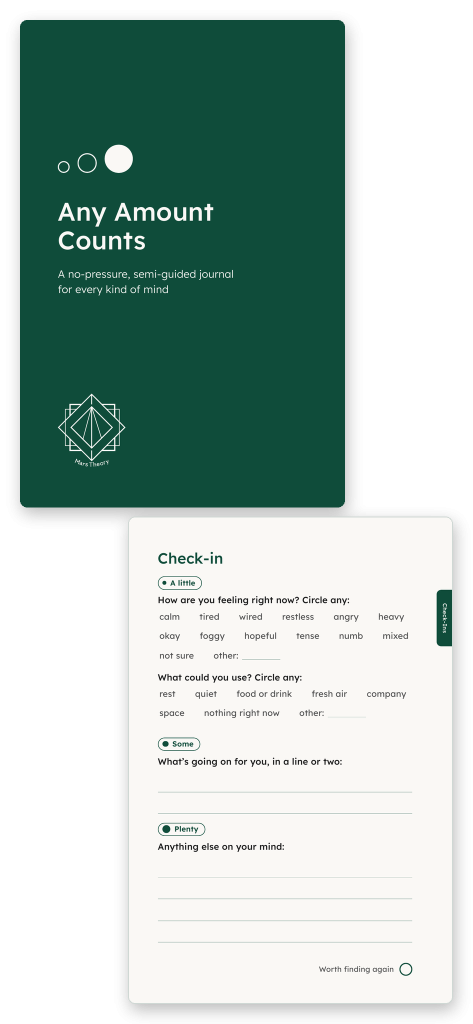
Any Amount Counts
A no-pressure, semi-guided journal for every kind of mind.
This journal was made for neurodivergent minds, harder seasons, or both. Every page with questions offers three ways in: circle a word, write a line or two, or keep going. A circled word, a line, or a full page all count the same.
You’ll find pages for low-energy days, feeling stuck, harsh thoughts, masking, and feeling too much or too little. There’s also a plan for hard moments, and plain-language explainers on ADHD, depression, anxiety, masking, and more.
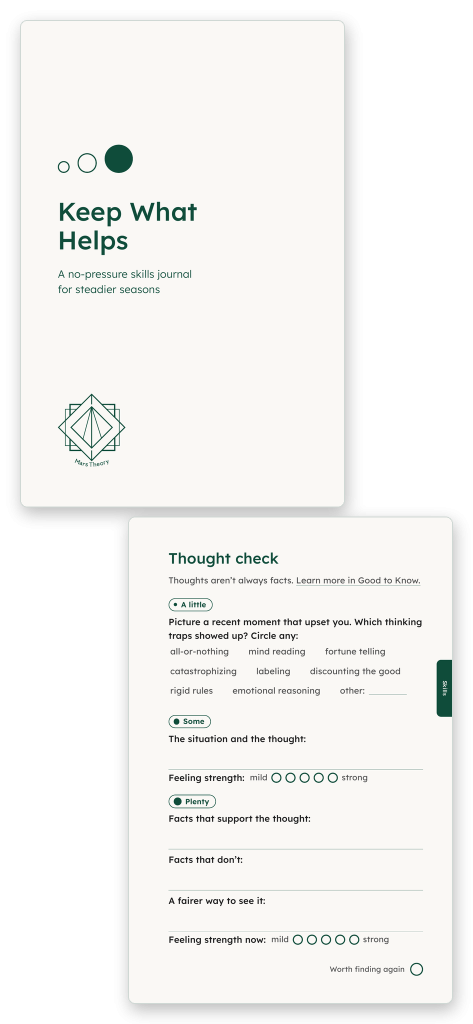
Keep What Helps
A no-pressure skills journal for steadier seasons.
Gentle, step-by-step pages drawn from CBT, DBT, and related approaches:
Checking a thought, sizing up a feeling, riding out an urge, small experiments, values, breaking down a goal, planning a hard conversation, and more.
What’s Inside Both Journals
- 16 check-ins, each with its own pair of questions and an extra page of room beside it
- 4 look-backs spread through the journal, each with its own questions
- One-question pages: 30 in Any Amount Counts and 31 in Keep What Helps, each question used only once
- Open pages in 7 layouts: lines, wider lines, dots, six boxes, two columns, a blank frame, and a center circle (33 in Any Amount Counts, 40 in Keep What Helps)
- Several copies of each tool or skill page, so you can use them more than once
- Good to Know: short, plain explainers, plus the research behind the pages, with full sources
- Support lines at the front and back, and on pages for hard moments throughout
Made to Be Easy to Use
- No dates, no streaks, and breaks of any length are okay. Start on any page and skip anything.
- Set in Lexend, a free font meant to make reading easier, with wide spacing and plain words. The layout follows ideas from the British Dyslexia Association’s style guide.
- Roomy writing lines, plus wider-lined pages for larger handwriting or tired hands.
- No page numbers. Instead, fill in a page’s “Worth finding again” circle to spot it later. Green tabs on the edge show what kind of page you’re on.
Research-Informed, Not a Replacement for Care
The pages draw on research about feelings, thoughts, habits, and getting things done. Each journal explains that research in plain words and lists its sources. No study has tested these journals themselves, and they aren’t therapy or medical advice.
Need support right now? In the US, call or text 988, any time. Outside the US, findahelpline.com lists free helplines by country.
Tablet or Printable?
Choose whichever version suits your needs:
Tablet version: 6 × 9 inch pages on a soft cream background. Open it in any PDF app that lets you write with a stylus or your finger. Tap any line on the contents page to jump straight there.
Printable version: US Letter pages on white (to accommodate cost-effective printing), with a wide left margin for hole-punching. Print the whole journal or just the pages you want. Matte cream or pastel paper can be easier on the eyes, and there’s a page at the back to test your pens.
Bound copies: Printed, bound copies may come later if enough people ask. Contact us if this is something you’d like to see.
Support Mars Theory
Both journals are free, and free is completely okay. If one helped and you’d like to give back, you can pay what feels fair here.